A client asked me something last month that I think a lot of business owners are quietly wondering: "Everyone keeps talking about AI automation agencies — but what do they actually do all day?" Fair question. The name sounds like something out of a tech conference, but strip away the buzzwords and it's a pretty simple idea.
So let's actually talk it through — no jargon, no "revolutionary paradigm shift" nonsense. Just what an AI automation agency does, how it's different from the marketing or IT firm you might already work with, and whether your business genuinely needs AI automation services in 2026.
Okay, So What Do They Actually Do?
An AI automation agency takes the boring, repetitive parts of running a business and hands them off to software. Not brand-new software, usually — most of these agencies aren't building AI models from the ground up. They're wiring together tools you've probably heard of (ChatGPT, Zapier, Make, sometimes a custom script or two) into a working system of business process automation, so tasks talk to each other and handle the grunt work without a person in the middle.
A lead fills out a form on your website. Right now, that probably means someone checks the inbox, decides if it's a real lead, manually adds it to a spreadsheet or CRM, tells the salesperson, and — if everyone remembers — a follow-up goes out a couple of days later. Multiply that by fifty inquiries a week and you can see where the hours go.
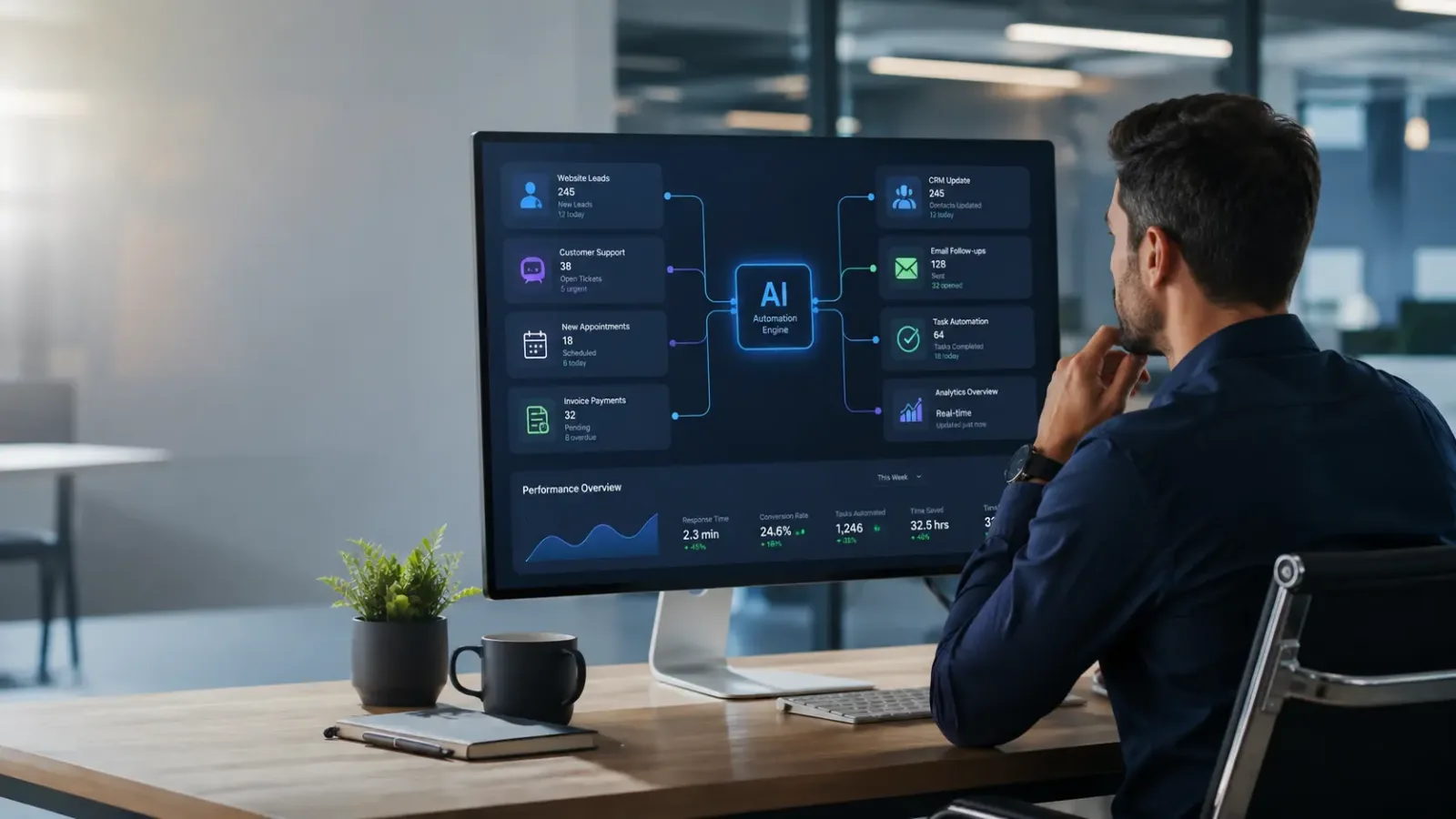
Here's what the same thing looks like once it's automated: a lead fills out your website form an AI chatbot or workflow qualifies the inquiry the CRM updates itself the right salesperson gets notified instantly a follow-up email or message goes out on schedule, no one needs to remember it. That's workflow automation handling a chain of tasks your team previously had to manage manually.
That's really the whole pitch of AI automation for small businesses. Less manual busywork, more consistency.
It's Not the Same as Hiring a Marketing Agency
I think this is where people get confused, honestly. A marketing agency runs your ads and writes your captions. A software company builds you an app. An AI automation agency does neither of those things — it's more interested in your operations than your brand. It walks through your day-to-day and finds the parts where a human is doing something a system could do just as well, if not better.
A few things this usually looks like in practice:
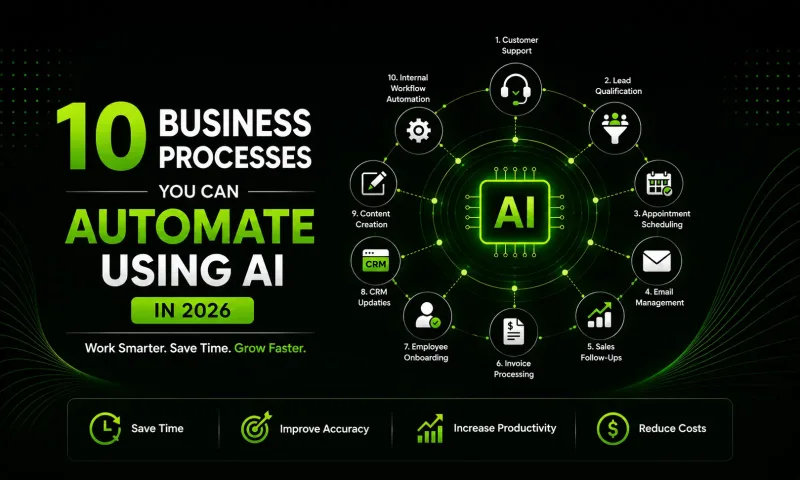
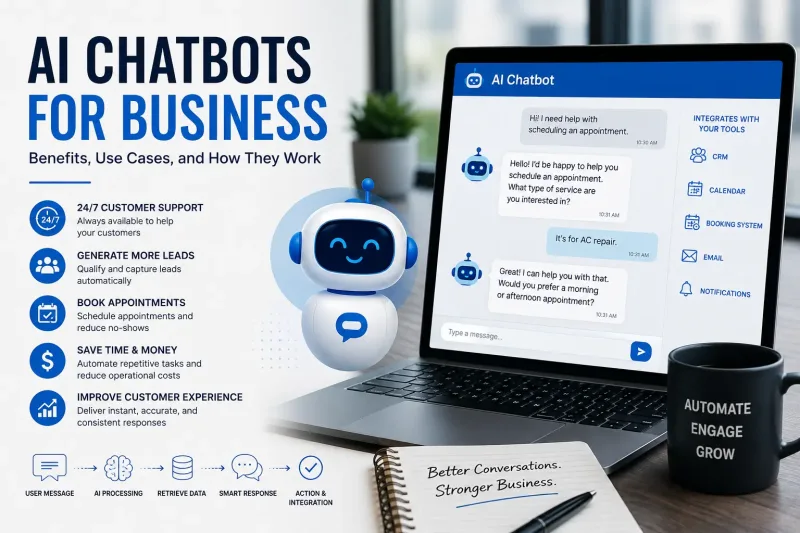
- A chatbot that answers customer questions at 2am, not just during business hours
- Follow-up emails and reminders that go out on their own after a lead comes in
- Invoices and payment nudges that don't require someone to remember them
- Basic social media scheduling, and sometimes first-response replies
- Resume sorting and interview booking, so HR isn't drowning in applications
None of this is glamorous work. It's the stuff that used to eat up three or four people's afternoons, now happening quietly in the background.
Why This Isn't Just Hype in 2026
I'll admit — a couple of years back, this whole space felt like it was mostly for big companies with big budgets. That's genuinely not true anymore. The tools got cheaper, no-code platforms got easier to use, and honestly, competition got tighter. If your competitor automated their follow-ups and you're still doing it by hand, they're going to look faster and more reliable to a customer, even if your product is better.
A few reasons this has become harder to ignore:
People expect a reply almost immediately now — doesn't matter if it's midnight. You can't staff a 24-hour support line easily, but a well-set-up AI system doesn't sleep.
Small teams are being asked to do the work of bigger ones. Hiring is slow and expensive, and honestly not always the right answer anymore. A team of three with good automation can genuinely keep pace with a team of ten that doesn't have it.
Mistakes go down. Someone typing a number wrong, or just forgetting to follow up — that happens constantly with manual processes. Automated systems aren't perfect, but they don't forget.
And maybe the biggest one: time gets freed up for the stuff that actually matters. Strategy, relationships, the creative decisions that no system can make for you.
Is AI Automation for Small Businesses, or Just Big Companies?
People sometimes assume this is a "tech company thing." It really isn't. A dentist's office, a real estate agent, a small coaching business, a local restaurant, a one-person online store — all of these have some corner of the business that runs the exact same way, every single day.
A real estate agent can automate lead follow-up so no inquiry sits ignored for a week. A clinic can automate appointment reminders so fewer people no-show. A store owner can automate shipping updates instead of answering "where's my order" fifty times a week.
Basically — if something in your business happens the same way over and over, there's a decent chance it can be handed off to automation.
How to Actually Pick One of These Agencies
A bit of a warning here, because the market's gotten crowded fast, and not every agency calling itself "AI-powered" actually knows what it's doing. Some things worth checking before you sign anything:
Ask to see real work they've done — not a slide deck, an actual example. Ask whether they can plug into the tools you already use, like your existing CRM or payment system, instead of asking you to switch everything. Start small — one process, one pilot — rather than letting them touch your entire operation on day one. And get clear pricing upfront, including what ongoing maintenance is going to cost you month to month, because that number tends to get glossed over.
One Honest Caveat
Automation won't fix a messy business. If your process is already confusing — nobody quite agrees on the steps, things get skipped depending on who's doing it — automating it just makes the mess move faster. It doesn't clean anything up. Worth mapping out how something actually works before you hand it to a system.
Where This Leaves You
Not every small business needs to automate everything overnight, and there's no single deadline where this suddenly becomes mandatory. But by 2026, it's fair to say an AI automation agency has gone from a "nice to have" to something more businesses are at least seriously evaluating — a bit like how having a website went from optional to expected over the last decade. The businesses that got in early, even in one small area, tend to be noticeably ahead. The ones waiting are, more often than not, playing catch-up now.
If you're not sure where to begin, don't try to automate everything at once. Pick the one repetitive task that eats the most time in your week, and start there. The rest can follow.
That's usually where a proper conversation helps more than another blog post. If you're not sure which part of your business to automate first, Softlyx offers a free AI automation consultation and workflow audit — a short session where we look at where your time is actually going and map out what's realistically worth automating first, without any pressure to sign up for everything at once.
Book a Free AI Automation Consultation with Softlyx

Comments (0)
Be the first to comment.